FOR PATIENT SUPPORT SERVICES & BRAND LEADERS
What Are the Other 95% of Your Patients Saying?
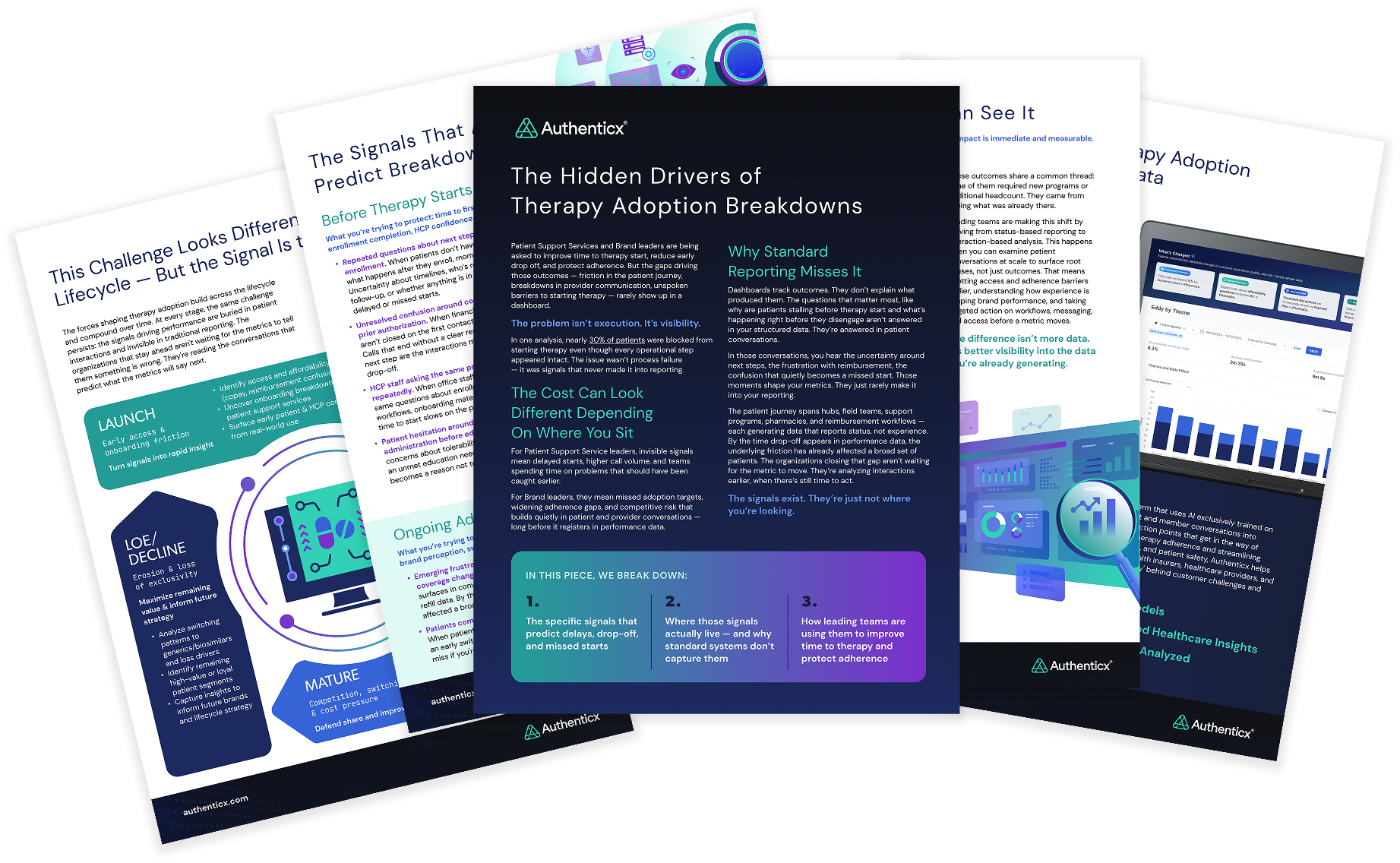
The Hidden Drivers of Therapy Adoption Breakdowns
Your programs are running. Your dashboards are full. But therapy starts are delayed, patients drop off, and the same gaps keep showing up, because QA teams only review 2–5% of calls. This guide shows you where the rest of that signal is hiding, and what to do about it.
In this guide, we break down:
The specific signals that predict therapy delays, drop-off, and missed starts at every stage of the patient journey
Why your current systems aren't capturing them and what's hiding them from view
How leading teams are acting on these signals before they show up in performance metrics
Trusted by leading pharmaceutical companies
20+
Proprietary Healthcare AI models
97%
AI Accuracy
500M+
Healthcare Conversations Analyzed
The Visibility Problem
See the signals your patient conversations are already revealing.
Most teams can track performance. Few can see what's actually driving delays, drop-off, and adherence gaps - because the signals that matter most don't live in dashboards. They live in patient conversations.
2%-5%
Seriously?
Average percentage of patient calls reviewed by QA teams. The other 95-98% go unreviewed, and unheard.
Some mentioned a side effect that no one ever flagged.
Some brought up barriers to treatment, but no one heard them.
Some called three times with the same problem. Then they stopped their therapy.
These aren't edge cases
They're hiding in the 95% of conversations you're not hearing. Now you can hear all of them.
What Changes When You Can Hear It All
See the signals. Act on them.

See what's driving drop-off
Understand why patients delay, discontinue, or disengage, with the context behind the numbers that dashboards alone can't surface.

Coach the moments that matter
Scale QA across up to 100% of interactions, not a sample, to catch what's really driving poor performance and adherence gaps, with built-in feedback that gets new agents up to speed faster.

Catch what a QA sample can't
Flag adverse events, product complaints, and compliance risks the moment they surface, not weeks later in a spot-check review.
Product Tour
Meet the Authenticx Platform
Navigate through the prompts to explore the Authenticx conversation intelligence platform.
Don't Just Take Our Word For It
What other pharma teams found in their own conversations.
6,000
At-risk patients recovered, $85M in saved revenue for one pharma manufacturer's field team
90
Days earlier to treatment after a hidden hub processing error surfaced in patient conversations
50%
Drop in delivery-blocker calls in two weeks once the barrier was identified
“All leaders can truly listen to the voice of the customer.”
“We were able to develop a scalable corporate listening program in which all leaders can truly listen to the voice of our customers on a regular basis.”
SVP, Sales and Marketing
Global Travel Medical Company
“It’s like watching your team’s game film.”
“We’ve always believed we’re a strong patient services team, but Authenticx challenges us in the areas where we can truly rise up and meet patients where they are.”
Pete K.
Director of Patient Support Services, Biopharmaceuticals
“Amazing!”
“The technology is so unique that it brings a whole new level of insights to our vendors and internally. It is an excellent way to understand your patients and providers.”
Katie A.
Associate Director, Patient Services Operations Biopharmaceutical Customer
See what the other 95% are saying.
Most organizations don't know exactly where patients are falling off therapy until it shows up in performance. This is a conversation about finding out where that's happening for you — and what it would take to fix it.
Understand your specific challenges. A focused look at where friction is showing up in your patient journey and what's driving it.
Get an honest read on fit. We'll tell you directly whether and how Authenticx can help. No pressure, no pitch.