Quality
Call Center Quality Assurance: A Complete Guide
July 6, 2026 by Molly Connor
Copied link
Key Takeaways
Call center quality assurance (QA) is the systematic process of monitoring, evaluating, and improving agent interactions to protect compliance, patient outcomes, and operational performance.
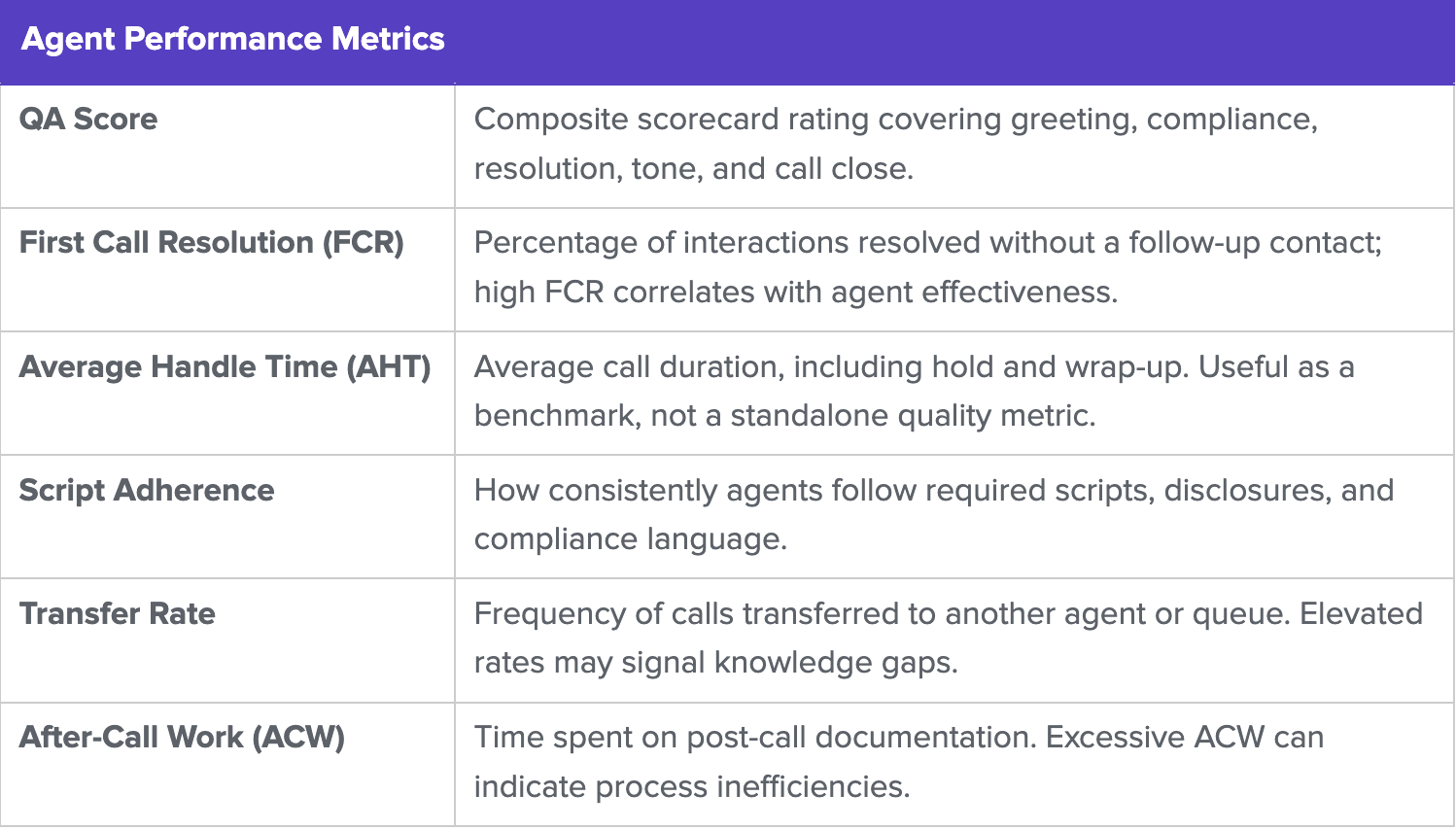
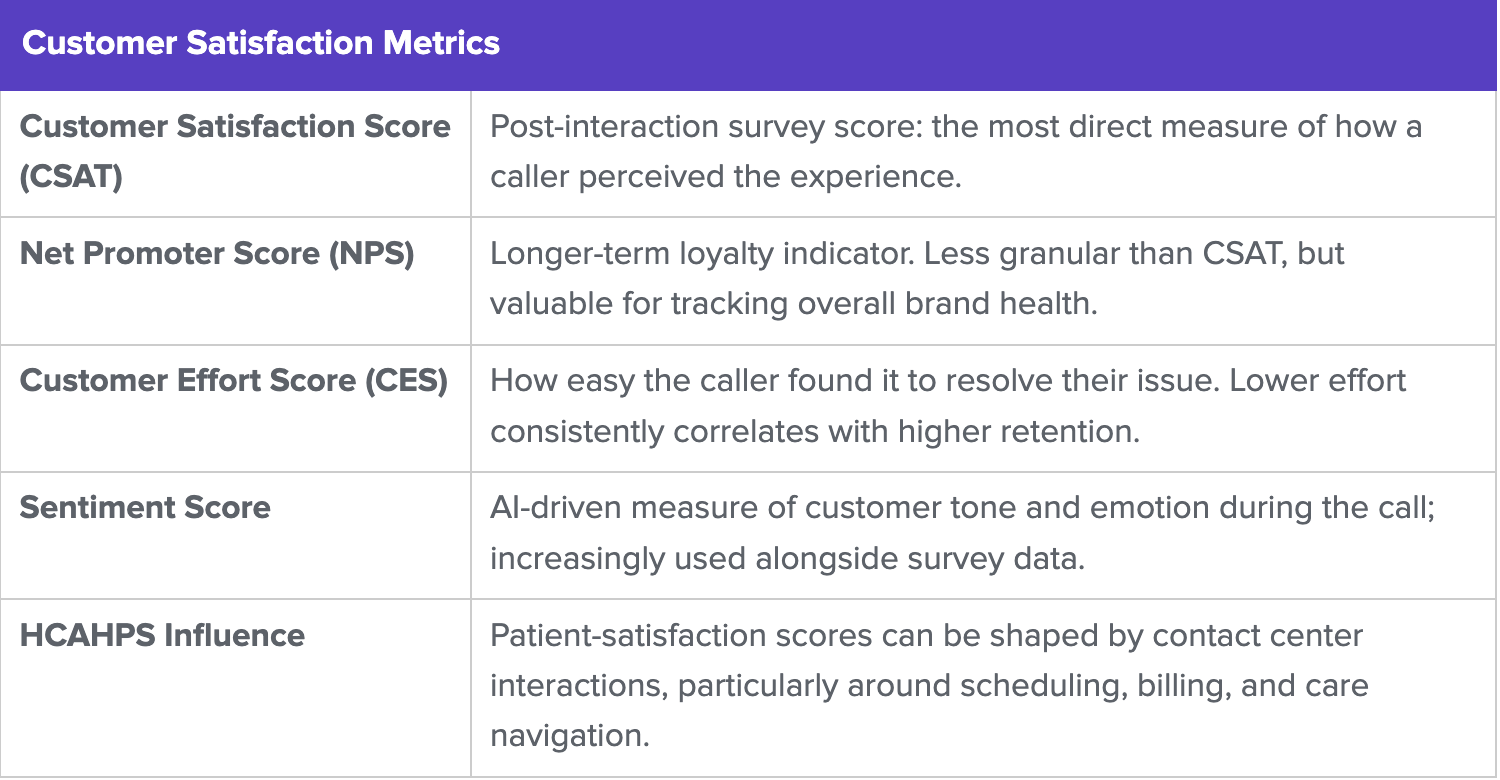
Effective QA programs track two categories of metrics: agent performance (FCR, AHT, QA score) and customer satisfaction (CSAT, NPS, sentiment).
A complete QA program requires three foundational elements: a scorecard, a consistent monitoring process, and a structured coaching framework.
Healthcare contact centers face unique QA requirements, including HIPAA compliance, PHI handling, and patient-safety screening.
AI-powered conversation intelligence now makes 100% call monitoring feasible, surfacing compliance gaps and coaching opportunities that manual review cannot reach.
Healthcare contact centers handle some of the most sensitive conversations in any industry. What happens on those calls, whether it is a patient navigating a billing dispute, a caregiver seeking prior authorization, or a member trying to understand their coverage, directly affects patient outcomes, compliance exposure, and agent performance. That stakeholder profile makes call center quality assurance software not a nice-to-have, but an operational imperative.
This guide covers everything healthcare quality and operations leaders need to build and sustain a high-performing call center QA program:
A clear definition of what call center quality assurance is
The key metrics to track
How to structure a program from the ground up
Best practices that separate effective programs from ones that stall
How AI is reshaping what QA can accomplish at scale.
What Is Healthcare Call Center Quality Assurance?
Call center quality assurance is the systematic process of monitoring, evaluating, and improving the interactions agents have with callers. A QA program defines quality standards, , measures actual performance against that standard, and creates a feedback loop that drives continuous improvement.
A typical QA evaluation covers several dimensions, including script adherence, empathy and tone, compliance language and disclosures, accuracy of information provided, and resolution quality. Healthcare and pharma face more scrutiny than most call centers, so those metrics expand to HIPAA disclosures, protected health information (PHI) handling, safety screening protocols, and care-navigation accuracy. Common call center quality monitoring formats include manual call monitoring, screen-recording review, automated speech analytics, and post-call customer surveys. Most programs use some combination of these, with the balance shifting as organizations mature their QA capabilities.
Quality Assurance vs. Quality Management
It is worth distinguishing QA from quality management. Quality assurance is interaction-level work that evaluates: evaluating individual calls, scores scoring agents against a scorecard, and provides coaching based on specific examples. Quality management (QM) is program-level work: designing the standards, reviewing aggregate data, and aligning the QA program with broader organizational goals. Both are necessary and neither replaces the other.
Why Is Quality Assurance Important in a Medical Center Call Center?
The case for call center QA is straightforward in any industry. In healthcare, it is more urgent. Poor call quality is not just a customer service problem; it can directly affect patient outcomes and satisfaction scores.
A well-run call center quality management program delivers several compounding benefits:
Consistent patient and member experience. When agents follow proven frameworks rather than improvising, callers receive accurate, compliant information regardless of who answers.
Early detection of training gaps. Quality monitoring surfaces individual and systemic skill deficiencies before they become entrenched patterns.
Compliance risk mitigation. Healthcare contact centers operate under HIPAA, CMS guidelines, and in some cases FDA-regulated adverse event reporting requirements. QA is the mechanism for verifying that agents meet those standards consistently.
Improved agent performance and engagement. Timely, specific feedback tied to real call examples accelerates agent development and reduces the defensiveness that vague feedback often creates.
Data to justify investments. Aggregate QA data makes the case for staffing adjustments, training programs, and technology investments in terms leadership can act on.
HCAHPS influence. Patient-satisfaction survey scores, including HCAHPS, are shaped by contact center interactions. Appointment scheduling calls, billing inquiries, and care-navigation conversations all contribute to how patients rate their overall experience.
Key Healthcare Call Center Quality Assurance Metrics
The two main categories of an effective QA program are agent performance metrics and customer satisfaction metrics. The right mix depends on program goals. Naturally, not every metric applies to every contact center, and chasing too many metrics at once often produces noise rather than insight.
The table below summarizes the core metrics in each category:
 See which QA metrics actually move performance
Authenticx scores 100% of healthcare conversations against the metrics that matter, so you can spot quality gaps and coach with evidence, not guesswork.
How to Build a Call Center QA Program for Your Medical Center
Building a QA program from scratch requires a scorecard, a monitoring process, and a coaching framework. Programs that skip or shortchange any of these three foundational elements tend to generate data without driving improvement.
Create a QA Scorecard
A QA scorecard is the evaluation framework agents are scored against. It should reflect your organization's specific priorities, compliance requirements, and the types of interactions your contact center handles. QA scoring is only meaningful when the scorecard is built on criteria that actually matter to your operation.
Common scorecard categories include:
Opening and greeting. Proper identification, required disclosures, and tone-setting.
Needs identification. Active listening, probing questions, and accurate problem framing.
Solution delivery. Accuracy, clarity, and appropriate escalation when needed.
Compliance. Adherence to regulatory language, HIPAA disclosures, and relevant scripts.
Empathy and tone. Patient-appropriate language, de-escalation, and emotional attunement.
Closing. Confirmation of resolution, next steps, and proper sign-off.
Healthcare-specific additions typically include HIPAA disclosures and PHI-handling protocols, safety screening questions, adverse event identification language for pharma and life sciences contact centers, and care-navigation accuracy checks.
When designing a scorecard, you should involve agents and team leads in the process. Scorecards built with frontline input see higher adoption and fewer disputes about fairness. Categories should be weighted by their actual importance. Compliance items should often be designated as auto-fail criteria rather than partial-credit categories, because a partially compliant HIPAA disclosure is still a compliance failure.
Establish a Monitoring Process
Once a scorecard exists, the next step is deciding how calls will be reviewed and how often. The primary options are manual review, AI-powered analysis, or a hybrid of both.
Manual review involves QA analysts listening to recorded calls and scoring them against the scorecard. It is thorough but limited in volume, typically covering only 1 to 5 percent of total interactions. That sample can miss emerging issues and create the risk that agents learn which calls are reviewed and adjust their behavior accordingly.
AI-powered monitoring analyzes 100% of interactions automatically, scoring each one against predefined criteria, surfacing patterns, flagging outliers, and prioritizing calls for human follow-up. When paired with an agent performance dashboard, AI monitoring transforms QA from a sampling exercise into a comprehensive view of contact center performance.
Regardless of approach, establish a consistent review cadence. Weekly or biweekly feedback cycles give agents enough time to apply learning while keeping evaluations close enough to the original interaction to be useful. Calibration sessions, in which the QA team scores the same calls independently and then compares results, are essential for maintaining scoring consistency across analysts.
Provide Agent Coaching and Feedback
QA data is only valuable if it drives behavior change. Coaching is the delivery mechanism. The best practice in most contact center environments is to deliver feedback within 48 hours of the evaluated interaction, while the specific details of the call are still accessible to the agent. Structured coaching tied to agent training and performance goals tends to produce faster improvement than general performance reviews.
Effective coaching sessions are built around specific examples pulled from actual calls, not generalizations. Distinguish between corrective coaching, which addresses errors or compliance failures, and developmental coaching, which builds on strengths and works toward higher-level skills. Real-time feedback tools can also surface in-the-moment guidance, reducing reliance on post-call review for coachable moments.
Track coaching outcomes over time. Are agents improving on the specific areas identified in QA reviews? Documenting progress creates accountability and gives supervisors data to distinguish temporary performance dips from persistent skill gaps.
Healthcare Call Center QA Best Practices
The difference between a QA program that improves performance and one that creates administrative overhead usually comes down to a handful of design and execution decisions. For healthcare contact centers looking to shift from a reactive to a proactive approach, these practices matter most:
Evaluate a representative sample.
Random call selection prevents agents from gaming monitored interactions. If agents know which calls are reviewed, QA scores reflect selective performance rather than consistent behavior.
Include agent self-evaluation.
Self-scoring before a coaching session improves self-awareness, reduces defensiveness, and often surfaces the same issues a supervisor would raise, which accelerates the coaching conversation.
Share aggregate QA trends with leadership.
Individual agent scores are useful for coaching. Patterns across teams and queues reveal systemic issues that require process or technology changes, not just individual coaching.
Review edge cases and escalations, not just average calls.
Outlier calls, whether unusually high-performing or problematic, often surface process failures or best practices that average calls do not.
Update scorecards at least annually.
QA criteria should evolve with business priorities, regulatory changes, and the introduction of new products or services. A scorecard built two years ago may not reflect what matters today.
Audit QA processes as part of compliance programs.
Healthcare organizations should document their monitoring methodology, review cadence, and calibration processes as part of broader HIPAA and CMS compliance documentation.
Avoid using QA scores as a punitive tool.
Programs built around discipline rather than development consistently produce lower agent engagement and higher turnover. QA data should drive coaching, not trigger consequences.
How AI Is Transforming Healthcare Call Center Quality Assurance
Traditional call center quality monitoring reviews a small fraction of total interactions, typically 1 to 5 percent, because manual review does not scale. AI makes 100% monitoring feasible for the first time, fundamentally changing what a QA for call centers program can accomplish.
AI-powered conversation intelligence automatically transcribes, categorizes, and scores interactions against predefined criteria at scale. Rather than waiting for a QA analyst to sample a handful of calls, the system surfaces every compliance gap, sentiment shift, and coaching opportunity across the entire call volume.
Specific capabilities that AI brings to healthcare QA include:
Pattern detection at scale. Conversation intelligence surfaces trends across thousands of calls simultaneously: common objections, recurring compliance gaps, topics that correlate with patient frustration, and language patterns that drive resolution.
Proactive healthcare outreach. In healthcare contact centers, AI can flag calls where patients expressed confusion, distress, or unresolved concerns, enabling care teams to follow up before issues escalate.
Analyst focus on complex work. AI QA tools reduce the manual burden of routine call review, allowing QA analysts to focus on complex cases, calibration, and coaching rather than transcription and basic scoring.
Real-time agent guidance. Some AI platforms provide in-call guidance to agents, surfacing relevant information or compliance reminders before a mistake is made rather than after a post-call review catches it.
AI QA tools must be trained on healthcare-specific language, regulatory terminology, and the clinical and operational context in which your contact center operates. Generic AI tools trained on broad call center data often underperform in healthcare environments because the vocabulary, compliance requirements, and conversation dynamics are distinct.
How Authenticx Improves Healthcare Call Center Quality Assurance
Authenticx uses AI-powered conversation intelligence built specifically for the complexity of healthcare contact center conversations. The platform analyzes 100% of patient and member interactions, scoring them automatically against quality and compliance criteria, identifying where performance gaps exist, and surfacing the evidence QA teams need to coach with precision. For organizations looking to move beyond sample-based monitoring, Authenticx provides the coverage, the context, and the healthcare-specific training that generic AI quality management tools cannot match.
The result is a QA program that finally keeps pace with call volume, catches compliance issues before they become audit findings, and gives agents the specific, evidence-backed feedback that actually changes behavior. Learn more about Quality & Coaching and see how Authenticx is purpose-built for the compliance, sensitivity, and scale of healthcare contact center quality assurance.
Bring healthcare-grade QA to every conversation
See how Authenticx helps healthcare contact centers monitor 100% of calls, surface quality and compliance gaps, and coach agents with real evidence.