Authenticx
The 2027 Star Ratings Are In. Your Next CAHPS Score Is Already Being Decided.
October 27, 2026 by Molly Connor
Copied link
The short version
The 2027 Star Ratings are final, and the CAHPS scores in them reflect member experiences from a year or more ago. The calls shaping your next scores are happening now.
Most lost CAHPS points sit between “usually” and “always.” They come from members whose issues were technically resolved but took too much effort, and those members never show up in complaint logs.
Waiting until a grievance is filed is too late, because complaints count against your Star Ratings too.
Authenticx proactively surfaces friction related to plan-related CAHPS questions around why and what to fix, before the next survey goes out.
The 2027 Medicare Advantage Star Ratings are out, and for many plans the results were tough. CMS released them on October 8. Only 15 contracts earned five stars, down from 22 last year, and 32 contracts landed at 2.5 stars or below, up from 23. The enrollment-weighted average slipped from 4.01 to 3.99 (Becker’s Payer Issues).
That’s no surprise given how the bar moved. A Newton Smith Group analysis reported by Healthcare Dive found that about half of the 2027 cut points got harder to reach, a third held steady and only about one in six got easier. When the whole industry improves, the bar rises with it.
The stakes don’t change. Plans rated four stars or higher earn quality bonus payments and bigger rebates, and that money goes straight into member benefits. For some plans, a half-star change is worth hundreds of millions of dollars. As our Chief Product Officer Eric Prugh put it, “Half a star isn’t a grade. It’s a benefits budget.”
Now that the results are in, most plans will spend the next few months working backward to explain them. But the member experience behind these ratings happened long ago. The experience that will shape the next ratings is happening on your calls today.
The survey is a rearview mirror
CAHPS asks a small sample of members to remember experiences from months ago. Then results arrive long after that. The CAHPS scores in this year’s ratings reflect calls that took place roughly a year ago or more. Whatever went wrong on those calls can’t be fixed now.
That leaves member experience leaders with an uncomfortable job: they own a number they can’t see until it’s locked in. The difference now is that the next survey hasn’t gone out yet. There’s still time to change what members will remember when it does.
Some plans read the recent CMS change, which cut the weight of CAHPS measures from 4x to 2x, as a sign they can relax. We’d argue the opposite. Member experience is still one of the few Star levers a plan can actually move within a single measurement year. A lighter weight makes it easier to overlook.
The points you’re losing are hiding in plain sight
Composites like “Getting Needed Care” ask members how often something happened: never, sometimes, usually or always. Most of the points still on the table sit between “usually” and “always.”
The member in that gap usually isn’t the angry one who files a complaint. It’s the member who got their prior authorization, but only on the second call. The one who eventually reached someone with an answer, just not the first person they spoke to. Their issue was technically resolved, so they never appear in the complaint log or the call driver report.
Then the survey arrives, and they check “usually.”
These moments are easy to miss in structured data, but easy to hear in a conversation:
“This is the third time I’ve called about this.”
“No one ever called me back.”
“I didn’t recognize the number, so I didn’t pick up.”
Your members are already telling you where “always” is slipping to “usually.” It happens every day, on your calls and chats, in their own words. The question is whether anyone hears it before the survey goes out.
From “what happened” to “why” to “what’s next”
Hearing the problem is only the start. To change a score, member experience leaders need three things, and they need them while there’s still time to act.
1. What problems members are having, across every conversation.
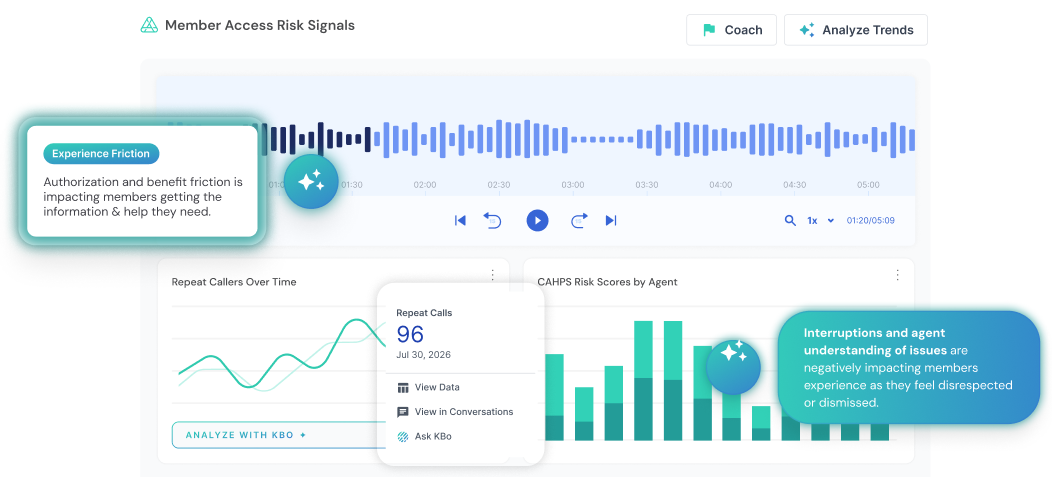
Random QA sampling can’t give a reliable picture of something this important. Authenticx’s new CAHPS reporting proactively surfaces friction and maps what it finds to the CAHPS survey questions about members’ experience with their health plan, such as getting needed help and information and being treated with courtesy and respect.
2. Why it’s happening, with the evidence to prove it.
A single CAHPS question often covers several different behaviors. “Did you get the help and information you needed?” depends on whether the representative offered assistance, took ownership, explained next steps and checked for remaining questions. So Authenticx breaks each of these questions into focused sub-questions, each with its own purpose-built model. Every result comes with the exact quote from the call that triggered it.
That’s the difference between knowing “courtesy scores might be at risk” and knowing that representatives say please and thank you consistently, but often interrupt callers or miss signs that a member is frustrated. One is a worry. The other is something you can coach.
3. A roadmap for fixing it.
Built-in AI summarizes the patterns behind each result and points to where to focus, whether that’s coaching on empathy, clarifying a confusing member letter or fixing a broken callback process. Results also roll up into a Member Experience Score, so teams can track progress over time and compare performance across programs, sites and teams.
Catch the issues no one tagged
By the time a member files a grievance or appeal, it’s already too late. Complaints and members leaving the plan both count in Star Ratings, so every one you prevent protects your score. And those complaints rarely come out of nowhere. They usually start as a confusing call, a missed callback or a second and third attempt to get an answer.
Most plans don’t see those early signs. They depend on frontline staff to tag calls correctly, and busy agents miss things.
Authenticx detects the moments when members express confusion, frustration or repeated effort, even when no one labeled the call. That gives plans time to step in, fix the problem and recover the member’s trust before a grievance is filed, while also reducing compliance risk.
Insight delivered to the people who can act on it
This isn’t another dashboard to monitor or another tool to manage. CAHPS reporting is built into the Authenticx conversation intelligence platform, so the results flow into the same reporting and drivers your teams use to understand every member conversation.
It also puts you ahead of the survey. Your survey vendor reports what members said, months after CMS scores you. Authenticx shows you what members are experiencing now, while you can still change how they’ll answer.
To be clear, these models don’t answer the survey for your members or replace CAHPS results from CMS. They do something the survey can’t: show you, call by call, the behaviors and signals most likely to shape how members answer the plan-related questions, months before those responses are recorded.
The plans that improve most will be the ones already listening
Every year, plans wait for their Star ratings and then work backward to explain what happened. The plans that gain ground will flip that order. They’ll listen to members now, understand why friction is happening and fix it before the next survey reaches a single mailbox.
Or, in Eric’s words: “The plans that improve the most won’t be the ones waiting on survey results. They’ll be the ones already listening to their members and acting on what they hear.”
Your next CAHPS score is being shaped on today’s calls. The members are talking. Make sure someone is listening.
See how Authenticx surfaces CAHPS risk before the survey does. Request a demo →