Authenticx
Improving Clinical Outcomes Using Sentiment Analysis in Healthcare
October 5, 2026 by Molly Connor
Copied link
Most healthcare contact centers review only a small slice of the calls patients make to them. Quality teams sample two to three percent of interactions, listen for compliance issues, and move on to the next batch. That leaves the early warning signs mostly undetected. A patient might grow more confused about their medication instructions over a few calls, but no one notices the shift until it turns into a formal complaint or a preventable readmission.
Sentiment analysis in healthcare exists to close that gap. Applied across sentiment analysis software covering 100% of patient interactions rather than a sampled few, sentiment analysis stops functioning only as a customer-experience metric. It becomes an early-warning system for clinical and operational risk, one that surfaces problems while they are still small enough to fix. This matters because the connection between how a patient sounds on a call and what happens to them clinically is not abstract: confusion about a discharge instruction has a documented path to a readmission, and unresolved frustration with a prior authorization process has a documented path to a delayed treatment.
This page looks at what sentiment analysis measures in a healthcare context, why it matters for clinical outcomes specifically, how it surfaces patient safety signals that manual review misses, and what a real sentiment analysis program looks like once it's built.
What Sentiment Analysis Measures in a Healthcare Setting
At its core, sentiment analysis is AI that classifies the emotional tone of a conversation: frustration, confusion, distress, relief, satisfaction. For a deeper look at the mechanics, see how sentiment analysis works.
Patient sentiment analysis differs from generic customer-service sentiment in one important way: the emotions it captures carry clinical weight. Pain, fear, medication confusion, symptom escalation, and caregiver distress are not just markers of a poor experience, they are markers of risk. A frustrated retail customer might abandon a purchase. A frustrated patient might skip a dose, delay a follow-up appointment, or stop calling back altogether, each of which has a downstream clinical consequence a retail sentiment score was never built to capture.
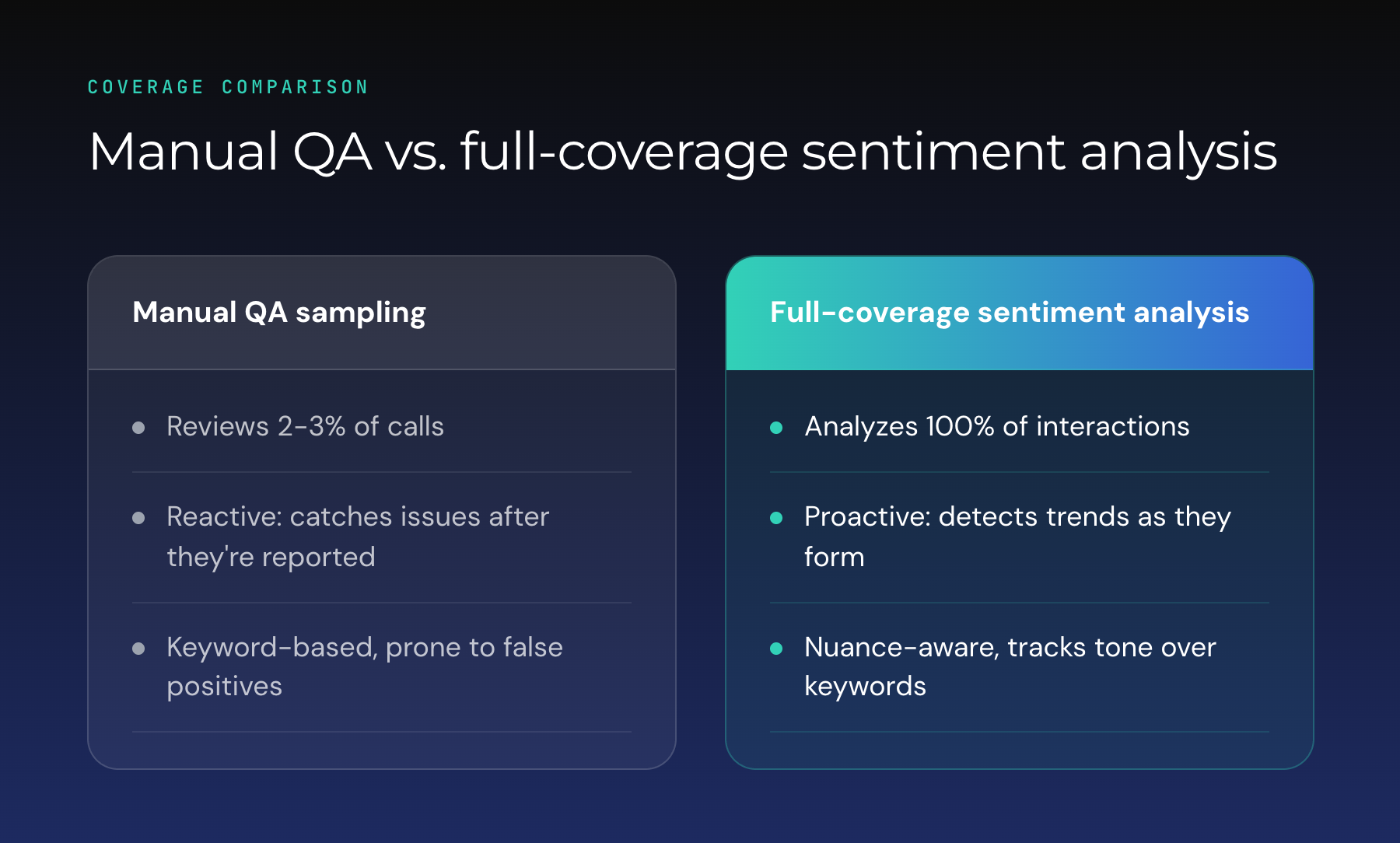
This is also where healthcare contact center sentiment differs by scale, not just by stakes. Most healthcare organizations manually sample only two to three percent of patient interactions. That leaves sentiment shifts in the other 97%-plus of conversations effectively invisible unless an organization has automated, full-coverage analysis in place.
Why Sentiment Is a Leading Indicator of Clinical Outcomes
Sentiment analysis improves clinical outcomes by surfacing the emotional and behavioral patterns that precede a bad outcome, before that outcome happens. A patient who repeatedly expresses confusion about medication instructions, or frustration trying to reach a care coordinator, is at elevated risk of non-adherence, delayed care, or an adverse event. Sentiment analysis flags that pattern while it is still a pattern, not after it has already become a clinical incident.
Authenticx calls the underlying framework for this the Eddy Effect: a patient caught in a recurring, unresolved loop of friction, rather than experiencing one isolated bad interaction. Consider a patient who calls three separate times about a prior authorization delay. Reviewed individually, each of those calls might read as a routine, if tense, service interaction, nothing that would trip a keyword-based alert or draw a reviewer's attention. Reviewed together, with sentiment trending steadily downward across three touchpoints on the same unresolved issue, they describe something else entirely: a patient sliding toward a delayed procedure, a missed treatment window, or a formal complaint.
That distinction, one bad call versus three connected ones, is the difference between a satisfaction dip and a clinical outcome. Manual QA, sampling a small percentage of calls, is structurally unlikely to catch all three touchpoints for the same patient. Full-coverage sentiment analysis is what makes the pattern visible instead of leaving it buried across three disconnected transcripts that no single reviewer ever sees side by side.
From Sentiment Signal to Patient Safety Signal
Clinical outcomes and patient safety overlap, but they are not identical, and this is where sentiment analysis does its most differentiated work. Adverse events don't always sound like adverse events. A patient might mention dizziness in passing while asking about a refill, or downplay a side effect while confirming a dosage. Negative or escalating sentiment can surface these concerns before they get lost in an otherwise routine call.
Manual QA, built around keyword spotting, tends to miss this kind of nuance. It flags calls that happen to contain a specific trigger word and misses calls where the concerning signal is tonal rather than lexical. That produces two kinds of errors: false positives, calls that trip a keyword but pose no real risk, and false negatives, calls that describe a genuine safety concern in language a keyword list was never built to catch.
This is why coverage matters as much as sensitivity. Analyzing 100% of interactions, rather than a small sampled percentage, closes the gap between when a safety-relevant sentiment pattern first emerges and when a human reviewer would ever see it. Framed this way, the goal isn't to manufacture alarm around every negative call. It's risk visibility: giving quality and safety teams a reliable way to see the patterns that already exist in patient conversations, rather than relying on chance to surface them. The combination of adverse event detection built on full coverage, paired with patient safety indicators tracked over time rather than call by call, is what turns sentiment analysis from a satisfaction score into a safety tool.
Sentiment as a Quality and Compliance Signal
The same patterns that matter for patient safety also matter for quality and compliance. A call center where sentiment trends downward on a specific topic, discharge instructions, prior authorization, billing confusion, is a leading indicator worth surfacing to quality and compliance teams, not just to CX. Left in a CX dashboard alone, that trend reads as a satisfaction problem. Connected to clinical quality indicators, it reads as an early warning that a specific process or communication gap is putting patients at risk across many interactions, not just one. That reframing changes who reviews the pattern and how quickly it gets acted on.
How to Put Sentiment Analysis to Work
A real sentiment analysis program has three parts. First, it analyzes every patient interaction, not a sample, so coverage isn't left to chance. Second, it flags sentiment trends by topic, not just by call. A quiet problem that repeats across dozens of conversations stands out as clearly as one dramatic call, instead of disappearing into the volume. Third, it routes flagged patterns to whichever team is best positioned to act, quality, compliance, or care coordination, depending on what the underlying issue actually is.
At Authenticx, KBo is the mechanism that does this work. It processes conversation data across 100% of patient interactions and turns it into flagged, actionable patterns, rather than a spreadsheet of raw scores someone still has to interpret and route manually.
One caution worth building into any program from the start: sentiment scores are only useful when trended over time and tied to a specific topic or workflow. A single negative call is a data point, not a signal, and treating it as one invites both false urgency and alert fatigue. For more detail on turning individual scores into a working program, see these best practices for improving sentiment scores.
 See Sentiment Analysis Applied to Clinical Outcomes
Sentiment isn't just a CX metric. Applied to 100% of patient conversations, it's an early-warning system for clinical and operational risk, one that surfaces the friction patterns manual QA is structurally unable to see. See how KBo surfaces these patterns at scale, or explore the underlying sentiment analysis software for the product-level detail.
Manual QA reviews a fraction of your calls. See how Authenticx analyzes 100% of patient conversations to catch the sentiment and safety signals that drive clinical outcomes.