Authenticx
The Millions of $$$ Hiding in Your Member Conversations
September 4, 2026 by Molly Connor
Copied link
Average Medicare Advantage Star Ratings have declined year over year and now sit below 4 stars. Only about 40% of the plans offered last year held a rating of 4 stars or higher.
That threshold is not a vanity line. Falling under 4 stars means losing quality bonus payments, and for most plans that shortfall runs into the millions. And even more, that cost can be dramatically compounded by the enrollment and rebate effects that follow a lower public rating.
Star Ratings are not only a member experience score. CMS builds them from clinical quality measures, plan operations, administrative performance, and member experience together. But CAHPS — the survey that captures member experience — is weighted heavily within that formula, which means a soft CAHPS year can pull an otherwise strong plan below the line.
And CAHPS is a look-back. It is a small sample, collected months after the experiences it measures. By the time leaders see a change in their scores, the member experiences that drove the results are already long past.
None of this is news to the teams who live in it. The harder problem is that most member experience leaders are already stretched thin running the member services program itself, leaving little room to get ahead of the scores rather than react to them.
If you're trying to improve member experience, don't look to CAHPS scores alone. Understand what's driving member sentiment in the first place.
The Limits of Survey-Based Measurement
Most health plans already have access to significant amounts of data like survey scores, operational metrics, complaint volumes, quality measures, and call center reports. Yet, many leaders still struggle to understand what is actually causing member frustration.
Part of the problem lies in the nature of surveys themselves:
The feedback arrives too late. Months pass between the member interaction, survey completion, and final reporting. By the time a decline in getting care quickly shows up, the underlying issues have been running for months.
Response rates are limited. CAHPS captures feedback from a small portion of the population. Even at healthy response rates, leaders are deciding from a sample rather than the full picture of member interactions.
Scores lack specificity. A lower score flags that a problem exists but rarely explains the root cause. A drop-in customer service quality might stem from long hold times, confusing benefits, provider network issues, inconsistent agent guidance or, worse yet, or all of them at once.
The result: teams spend valuable time investigating symptoms instead of addressing causes — and the window to move next year's score closes while they look.
What Member Conversations Reveal That Surveys Can't
The "why" behind member sentiment isn't hiding. Members tell you exactly what's working and what's not, in plain sight, through phone calls, chats, emails, and other everyday service interactions.
Within these conversations are the details for how to improve member experience that CAHPS surveys often miss:
Specific reasons why members are feeling friction
Areas of confusion
Process and technology breakdowns
Unmet expectations
Agent behavior patterns
Emerging concerns before they become widespread problems
You already have access to this information. But scaling it manually across thousands or millions of member interactions is impossible.
This is where conversation intelligence adds a new layer of visibility.
Rather than relying on a small survey sample, conversation intelligence analyzes member interactions across all your channels to identify patterns, trends, and recurring themes. The result is a more complete voice-of-the-customer strategy that combines survey outcomes with the experiences driving them.
Mapping Conversations to CAHPS Performance
Conversation intelligence doesn't replace CAHPS surveys. It surfaces what could be driving down scores months before CMS does and you can see the reasons while you can still do something about it.
Our CAHPS models score every conversation and map to the pertinent questions members are actually asked, so you can proactively address areas that may show up on a survey and negatively affect the plan’s Star Rating:
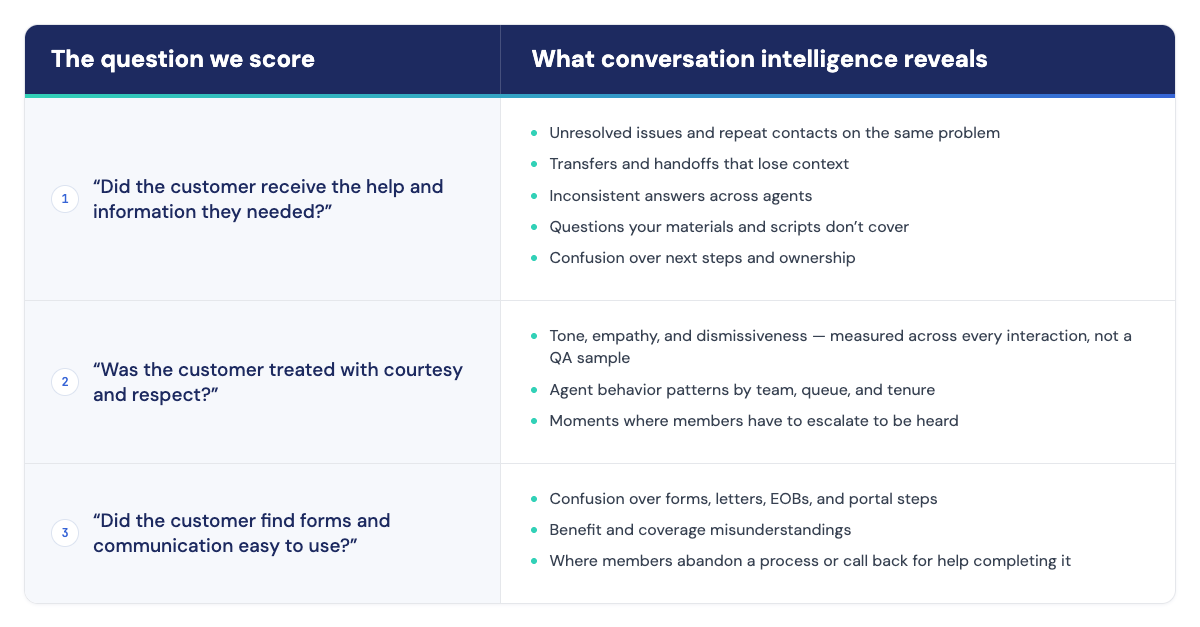
Why This Matters for Medicare Advantage Plans
For Medicare Advantage organizations, member experience isn't simply a customer service initiative. It's a business imperative, as Star Ratings influence revenue, growth opportunities, competitive positioning, and long-term viability.
For one health plan, Authenticx pinpointed three specific drivers for a client behind a high-volume of repeat calls, turning a nameless volume problem into a prioritized action plan — the same kind of visibility that's helped Medicare Advantage plans save 300 agent hours a month and cut average call time 18%
The organizations that improve member experience most effectively are those that look beyond CAHPS scores themselves and focus on understanding the experiences behind them. By combining traditional survey measurements with ongoing insights from member interactions, you can move from simply tracking performance to actively improving it.
Moving From Insight to Action
When you can identify emerging patterns in member conversations, you gain more opportunities to make changes before issues become systemic. Use conversation insights to:
Improve coaching and training: Look for recurring questions, points of confusion, and moments where members consistently need additional support. Then, use these insights to refine your training programs, strengthen messaging, and improve communication practices.
Identify operational bottlenecks: Pay close attention to recurring complaints that surface across large volumes of conversations. Many member experience challenges originate outside the contact center and point to larger process, policy, or system issues. Pinpoint where bottlenecks occur and collaborate across departments to reduce friction before it impacts satisfaction scores.
Detect churn earlier: Monitor conversations for early signs of dissatisfaction, including repeated effort, unresolved issues, benefit confusion, or expressions of frustration. Renewal decisions are often shaped by months of cumulative experiences rather than a single interaction.
Improving your plan's CAHPS survey results is possible, but not with metrics alone. Conversation intelligence is the layer between an annual look-back and a Star Rating you can still influence, with deep analysis of 100% of the member interactions your team handles every day.
Learn more about how health plans are using conversation intelligence to uncover member experience insights hidden in everyday interactions.