Authenticx
Skip the Market Research Report. Hear It in Real Time.
September 29, 2026 by Molly Connor
Copied link
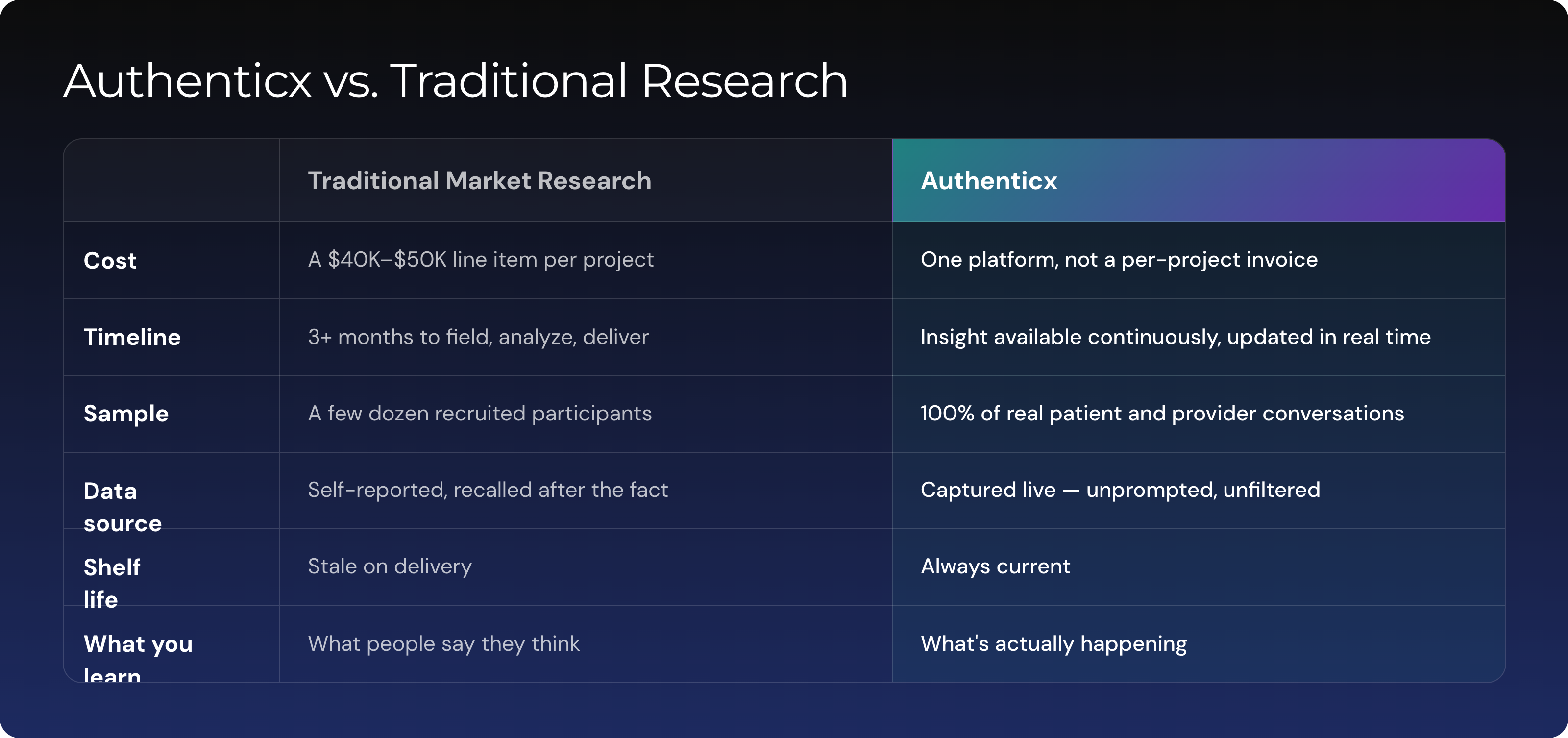
Brand leaders in pharma are used to the drill: scope a study, scope a study, write the RFP, wait for the study to run, then wait again for the analysis. Three months and $40,000–$50,000 later, you get a report. By the time it lands, the market has already moved.
Meanwhile, every access call, every side-effect question, every "I've called three times and no one's fixed this" is already sitting in your contact center. Your patients and providers aren't waiting to be recruited into a study. They're telling you in realy time. You're just not set up to hear most of it.
The Market Research Industry Is Bigger (and Slower) Than Most Brand Teams Realize
Market research isn't a rounding error in a pharma marketing budget. Pharmaceutical and healthcare companies have consistently accounted for around 16% of global market research spend, a share that's held steady for over a decade, according to ESOMAR's Global Market Research reports. And that market keeps growing: per ESOMAR's Global Market Research 2025 report, the global market research sector reached $56 billion in 2024, part of an overall insights industry that had already surpassed $150 billion that year — with ESOMAR, writing in late 2025, projecting it would cross $160 billion by the end of that year.
Put pharma's historical share against just that $56 billion market research slice, and it's close to $9 billion a year moving through a model that, by design, only ever sees a fraction of the picture: a few dozen recruited participants, a three-month lag, and a report that's outdated the moment it's delivered.
The Blind Spot No One Talks About
Here's the number that should worry every brand team: a typical QA team reviews only 2–5% of patient calls. That means 95–98% of every patient conversation goes unreviewed and unheard. Not spot-checked, not sampled, just gone. Somewhere in that silent majority is the adverse event no one flagged, the access barrier no one heard, the patient who called three times about the same problem and then quietly stopped their therapy.
Your last research study covered a few dozen recruited participants. Authenticx uncovers 100% of your patient conversations: no recruiting, no sample, no gap between what you hear and what's actually happening.
 None of the following came from a survey. It came from listening to the conversations already happening:
92% of disrupted patients wanted to stay on therapy. The system was the obstacle.
51% decrease in negative sentiment through a better call opening.
30% fewer product complaints after addressing three experience gaps.
Patients and providers said all of this on their own, in the ordinary course of getting help. It was there to hear the whole time.
The Signals Compound Across Your Product's Lifecycle
This isn't just a launch problem or a mature-brand problem. It's the same blind spot, showing up differently depending on where your product sits:
Launch: Early access and onboarding friction hide in copay confusion, reimbursement questions, and patient support breakdowns before you ever see a missed-start rate move.
Growth: Patients who go quiet in a support call, or start comparing your therapy to alternatives, are giving you a switching signal months before it shows up in adherence data.
Mature: Provider frustration surfaces in support interactions long before it shapes the recommendation a patient hears at their next visit.
LOE/Decline: Even switching patterns to generics or biosimilars, and which patient segments stay loyal, are sitting in conversations your teams are already having.
In one analysis, nearly 30% of patients were blocked from starting therapy even though every operational step looked intact. The breakdown wasn't in execution, it was in visibility. Once that friction surfaced, one team cut time to therapy from 30 days to 12; another reduced a single infusion-access barrier from 71% of conversations down to 12%. None of it required a new program, a bigger team, or a fielded study. It required listening to what was already being said.
Insights Workshops: Your Market Research Team, Built In
Insights alone don't drive change. People do. That's why Authenticx clients can bring in our in-house experts to facilitate Insights Workshops: guided session that turns your conversation data into a clear, cross-functional action plan, not a report that just shows up in your inbox.
Context: Understand the meaning behind conversations and the root causes behind trends and shifts.
Clarity: Craft your customer story from data collected straight from your patients' and providers' own words.
Connection: Bring the voice of the customer into business decisions, from the boardroom to the frontline.
Stakeholders leave aligned on priorities, with an action plan, not a 40-page slide deck.
Beyond the Workshop: Always-On Insights in Authenticx
Competitive intelligence. Hear what patients and providers are really saying about competing therapies (discontinuation reasons, side-effect concerns, switch intent) straight from conversations, not a tracker study.
Always-on dashboards. Get insight delivered where you already work, through Insights Cards, Spotlights, and scheduled dashboards, so you're never waiting on the next fielding window.
KBo Research Mode. Save a search, brief KBo on what you're tracking, and get a structured analysis delivered to your inbox automatically, on a schedule you set. No dashboard login required.
Your Next Market Research Study Is Already Happening
You don't need another $50K line item and another three-month wait to know what your patients and providers are experiencing. See what they're already telling you, and what it could mean for your next research spend.