Authenticx
When Patients Can’t Start Therapy, the Answers Are Already in Your Calls
May 1, 2026 by Molly Connor
Copied link
The Back Story
A leading pharmaceutical manufacturer had just launched a new infusion therapy for an elderly patient population. The support infrastructure was in place. Specialists were trained. Patient services teams were staffed and ready.
But patients weren’t starting therapy.
Something was getting in the way, and traditional reporting couldn’t pinpoint it. The manufacturer needed to understand not just that patients were struggling, but why, in their own words.
The A-Ha Moment
In the eight months following therapy launch, Authenticx analyzed thousands of real conversations between patients, caregivers, healthcare providers, infusion site staff, and patient support specialists.
Within the first 30 days, three significant friction points emerged, all hiding in plain sight:
Consent forms were failing patients before they even started. Patients and caregivers couldn’t navigate the required online forms and signature processes. For an older population that relied on caregivers for support, but whose caregivers didn’t always have authority to provide consent, this barrier was compounding quickly. At the time of discovery, one in three conversations about consent forms ended unresolved.
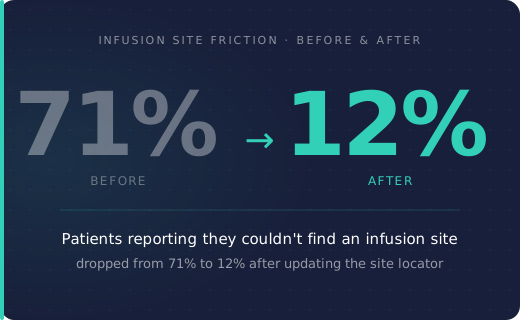
Infusion site information was contradicting itself. Patients were receiving conflicting information about which sites could actually administer the therapy. Some had to travel unexpected distances. Others, who were traveling away from home, couldn’t find a site at all. The result: nearly 3 in 4 patients (71%) who mentioned infusion sites in calls reported they hadn’t yet begun therapy because they couldn’t find one.
Insurance and cost questions were going unanswered. With a newly launched drug came new coverage complexity. Patients and caregivers were stuck trying to decode Medicare requirements and diagnostic costs, creating friction at the exact moment they needed clarity. Those in the diagnostic stage experienced the most friction across the entire patient journey.
The data didn’t just identify problems. It quantified them and made it impossible to look away.
The Intervention
Armed with this evidence, marketing and patient support leaders moved quickly.
The consent form process was redesigned with simpler online instructions, paired with more structured coaching for support specialists to guide patients through it. The Infusion Site Locator on the therapy’s website was updated to reflect reality, so what patients heard in calls matched what sites were actually able to offer. And the team created clearer guidance on costs and diagnostic coverage, so patients and providers could stop guessing.
These weren’t sweeping overhauls. They were targeted, evidence-backed fixes, made possible because the manufacturer knew exactly where the friction was.
The Impact
The results confirmed what the conversations had been signaling all along.
Unresolved consent form conversations dropped from 33% to 14%, more than cut in half
Calls citing trouble finding an infusion site fell from 71% to 12%
Non-participating infusion sites began calling in, asking how to get certified to administer the therapy
Patients in the diagnostic stage received clearer cost and coverage guidance
Front-line specialists were equipped with better tools to support patients end-to-end
More patients reached their first infusion. More calls reached resolution. The therapy’s support ecosystem caught up to the patients it was meant to serve.
What This Makes Possible
Patients were calling in every day, describing exactly what was blocking them. The challenge wasn’t a lack of signal. It was the ability to hear it at scale and translate it into action.
Conversation intelligence gave this manufacturer both. And the friction that had been slowing therapy adoption for months was resolved in weeks.
If your patients are struggling to start therapy, they’re already telling you. The question is whether you’re listening.
See how Authenticx surfaces what’s hiding in your patient conversations →